At a recent bodybuilding competition in Tokyo, spectators were vocal in their praise.
They shouted words of encouragement, such as, “Huge!” “By far the best conditioned!” and “Those legs are incredible!” each time contestants struck poses on stage.
But these were not professional bodybuilders flexing their muscles.
Instead, the sport has attracted a growing following among college and university students in Japan in recent years.
On Sept. 27, the All-Japan Student Bodybuilding Championships were staged for the first time at the University of Tokyo’s iconic Yasuda Auditorium.
The championships took place over nine hours, characterized by competitions in three categories.
As repeated rounds of posing were conducted, judges assessed the chest, back and other torso parts in individual-muscle evaluations. Meanwhile, comparison rounds saw athletes assessed side by side.
SURGE IN POPULARITY
More and more male students are embracing bodybuilding whereas the sport was once considered a “niche” pursuit. Participation in the Kanto regional championships, held in and around the capital, has increased 6.5-fold over the past decade.
The rise of social media and the creation of new competition categories have fueled the latest trend, leading young people to take up the challenge of gradually developing their physiques through weight training.
The number of student competitors has dramatically soared recently.
According to the All-Japan Student Bodybuilding Federation, entries in the Kanto Student Championships rose from 44 in 2016 to a combined 289 this year across the bodybuilding and physique divisions, with the latter introduced in 2019.
A women’s beginners fitness category was similarly added in 2023.
Spectator numbers have also surged, prompting the organizer to secure venues with capacity for 1,000 people since 2019, replacing the several-hundred-seat halls previously used.
Social media has played a major role in broadening interest in showcasing well-developed physiques.
Though opportunities to see elite bodybuilders were once largely limited to competitions and specialized magazines, people can now follow them daily through social media platforms.
Exposure to such online content is said to have inspired many students who “simply want to improve my appearance” to embark on muscle improvement programs.
“Training tips have been widely shared via the internet, raising the overall standard of competition,” said Yun Hashimoto, then president of the student federation and a fourth-year member of the University of Tokyo’s Bodybuilding and Weightlifting Club.
The introduction of the physique division has likewise drawn newcomers to the sport, because it offers a lower barrier to entry than traditional bodybuilding that evaluates the body as a whole.
The new physique category rather places greater emphasis on upper-body aesthetics and overall balance. Moderately developed musculature is generally favored, and contestants wear board shorts instead of posing trunks.
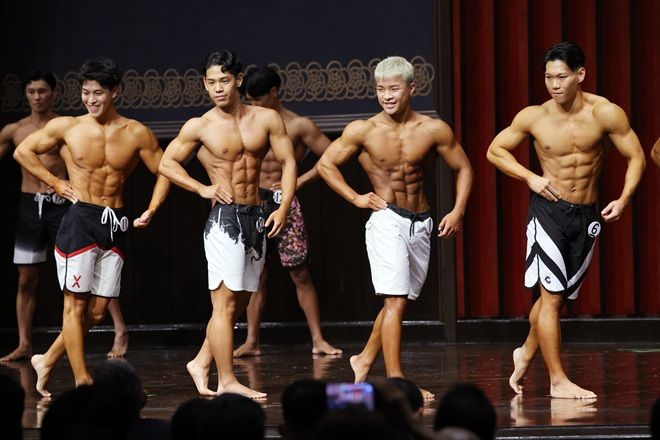
The physique division recorded 163 competitors at the Kanto championships this year, 37 more than the bodybuilding category, including double registrants.
The first national championships at Yasuda Auditorium marked a significant milestone for collegiate bodybuilding in particular, as the venue is regarded as one of the most recognizable landmarks of Japan’s most prestigious university.
The dream project became a reality after the organizer failed to secure its usual venue. Donations from former members of the school’s Bodybuilding and Weightlifting Club were fully utilized to fund the rental of Yasuda Auditorium.
“Our hope is that organizing the event at a site familiar to people nationwide will demonstrate that student bodybuilding is evolving into a major competitive sport,” Hashimoto said.
STEADY EFFORT SHOWS ANYONE CAN CHANGE
Modern society often emphasizes efficiency and maximizing results in minimal time. Yet, bodybuilding remains a discipline in which progress ultimately depends on persistent effort, regardless of how much advice on effective training is available online and elsewhere.
What is daily life like for student bodybuilders?
“The effort you put in comes back in measurable results and visible changes,” said Keita Matsuoka, a junior at the University of Tokyo and captain of its Bodybuilding and Weightlifting Club, describing the appeal of the sport. “Anyone can transform themselves.”
He finished 15th at the All-Japan Student Bodybuilding Championships.
Matsuoka began bench-press training during high school as part of his judo preparation. He committed himself seriously to bodybuilding in the spring of 2024 shortly after entering university.
By working out four to five times a week, Matsuoka maintained a daily intake of 4,000 to 5,000 calories. His physique expanded rapidly, with his weight rising from 70 kilograms to 94 kg within a year despite standing 174 centimeters tall.
Toward the end of 2025, Matsuoka started cutting weight for this year’s competition.
Living with his family, Matsuoka cooked four meals a day himself while relying on such foods as chicken breast and mackerel to closely manage his calorie intake. As a result, his body fat percentage fell significantly and his weight declined to 71 kg.
Currently, Matsuoka makes sure to get eight hours of sleep, which is essential for muscle recovery and growth.
A science and technology studies major in the College of Arts and Sciences, he works twice a week as a private tutor while adhering to a rigorous regimen focused on training, nutrition and sleep.
Matsuoka acknowledged that devoting a significant portion of his student years to bodybuilding may not necessarily yield direct practical benefits later in life.
Nevertheless, Matsuoka believes students stand to gain more from bodybuilding than just physical strength.
“Setting long-term goals, breaking them down into daily actions and sticking to them consistently allows you to see how far you have come,” he said. “The confidence built through that process can contribute to a richer and more fulfilling life.”
* * *
The original article in Japanese is available here. Please note that a paid subscription is often required to read the full Japanese version.