Every morning, Pawan Gharti Magar and Rajani Rai travel to a gym that lies kilometres away from where they stay. Magar, who lives in Tokha, rides for around 20 kilometres to reach the Himalayan Fitness and Gym in Satdobato, Lalitpur. Rai, who lives in Jorpati, takes a 15-kilometre ride to reach the same gym.
Magar has a short stature, and Rai is a wheelchair user with an L5 spinal injury. They are the two Nepali para powerlifters who got wildcard entries to the Asian main event, taking place in Nagoya, Japan, from October 18. They will be competing in the bench press category. Training at a nearby gym would have saved them time and resources, and offer more time for recovery after demanding sessions. But the gym in Satdobato is the only one which has a specialised bench for para powerlifters.
Magar and Rai have faced a lot of hurdles already after joining para powerlifting and representing the country at the world stage. But they are still continuing despite the state continuing to neglect them. They want to show how far they can go despite zero support from the state. They say they do it for the love of the game, inspired by nothing but a desire to put Nepal on the world para powerlifting map.
Before they can contend with the plates on the bar, para powerlifters must contend with the limitations of their own bodies. Able-bodied athletes do the bench press with their legs down, supporting their lift. Para athletes, meanwhile, compete by lying on a World Para Powerlifting-approved bench. Magar and Rai arrive at the gym in turns because a single bench is not sufficient for both to come at once and practice.
But the troubles do not exist in accessibility alone. While the gym has not charged the duo for using the facility, Magar and Rai have been covering the cost of their travel, diet and necessary accessories through the money they earn by doing jobs.
Arriving at 7am on an e-bike, Magar trains up to 8:30am and leaves for Samakhusi, where he works at a manpower company, giving orientation to migrant workers.
Rai, meanwhile, reaches the gym at 9am on a modified scooter, with coach Kelvin Maharjan waiting at the gym’s doorsteps to help her enter the gym. She needs assistance to enter and exit the gym, which has a raised concrete threshold at the entrance that forces visitors to step high or hop over—an insurmountable barrier for anyone on wheels.
The troubles that Magar and Rai go through to reach the gym daily, except on weekends, are not for themselves. It is all for winning medals for the country, the athletes say.
Rai works online at CloudFactory, a software company. “I come to the gym after completing half of my work,” she said. “I return to my room and sit in front of my laptop again.”
In 2013, Rai, who was then 14, fell off a tree in her home district of Khotang and injured her spine. After receiving treatment at the Dharan-based BP Koirala Institute of Health Sciences, Rai relocated to Kathmandu, where she could get easy access to regular follow-up and continue her education.
Doing powerlifting while in a wheelchair was, meanwhile, something that Rai had never thought of.
“I used to play different sports when I was all well,” Rai said with a wide smile. “I had thought of trying some other para sports, but when I found out that I could also do powerlifting, it changed everything.”
Rai’s first international participation was the 2017 WPPO Asian Youth Para Games in Dubai. She had participated as a newbie.
“Powerlifting was completely new to me then,” Rai recalls. After training for a couple of months, she went to Dubai and took part in the Asian Para Games. “It was a great experience,” she says.
Rai credits Tek Bahadur Gurung, the president of the National Para Powerlifting Sport Association of Nepal who she refers fondly as ‘Tek guru’, for introducing her to the sport in 2017.
Rai has not stopped lifting weights since then. She has participated in three national tournaments after that, winning them all.
But these years have not been easy for her. The lack of proper funding and investment in para powerlifting has led Rai to spend out of her pocket to fight for a medal for the country. “Let’s see how long I can continue,” Rai added with a grin.
Magar said he also wants to test how long he can continue lifting weights as a national para powerlifting athlete.
“I think I can keep lifting weights for a long time in the future,” Magar said, flexing his biceps.
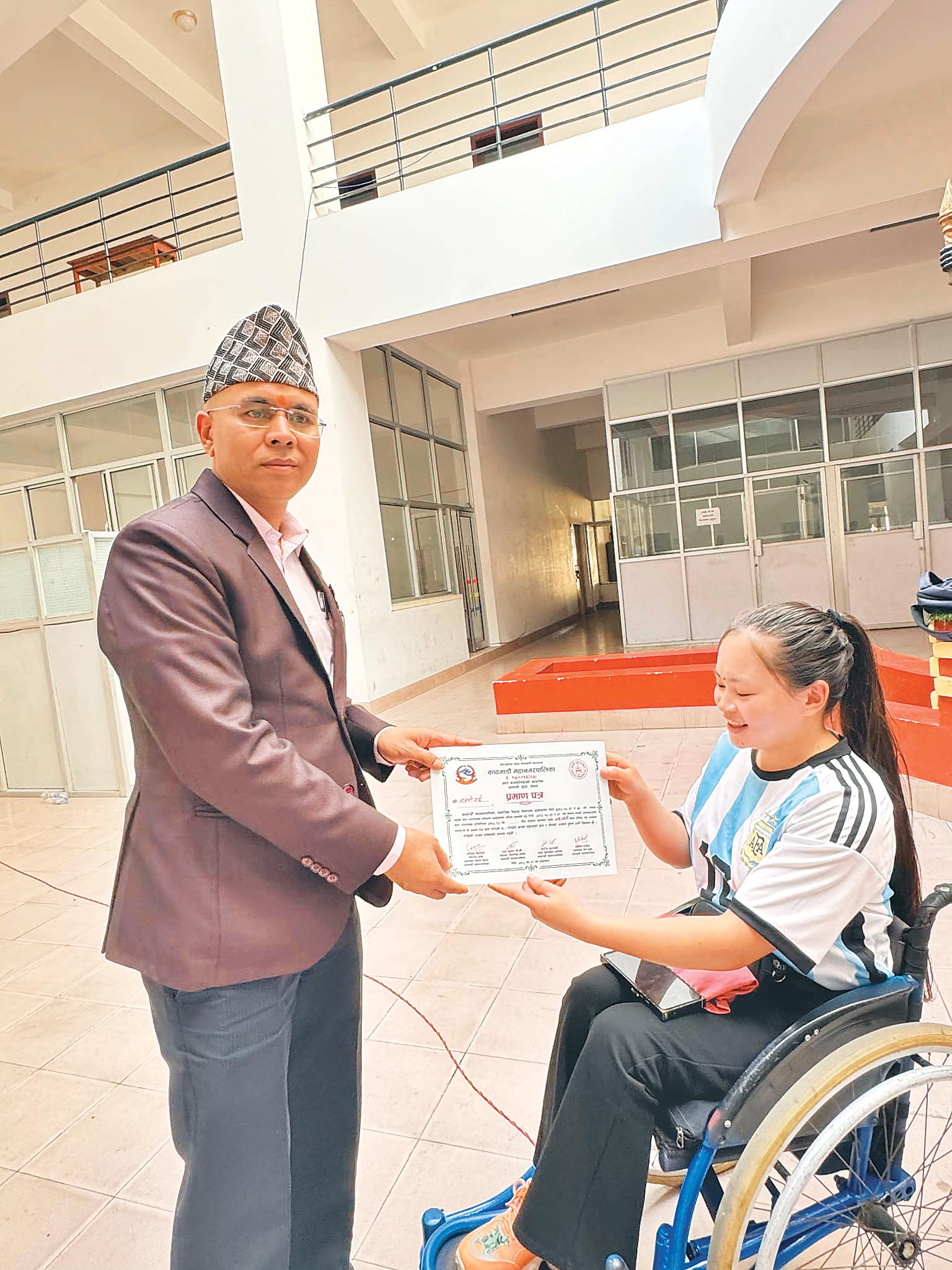
Magar clinched gold in his weight category (up to 49kg) at the valley-wide para powerlifting championship organised with the support of Kathmandu Metropolitan City in June. There he also set a new personal record, lifting 90kg.
The bench, which was donated by the World Para Powerlifting (WPPO) in collaboration with ZKC Barbell Co, for the championship was carried from the gym in Satdobato as there are no other benches for para powerlifters in the country.
“I know the gap between me and the para powerlifters around the world,” Magar said, catching his breath after an intense training session at the gym. “If I could get at least half the facilities those world-class powerlifters get, I could beat them.”
Even Magar cannot get access to the bench all the time because travelling daily to Satdobato from Tokha throughout the year does not just fit in.
“Whenever there is a tournament, I start going to Satdobato,” Magar told the Post. “On other days, I go to a gym near my room in Tokha to stay in form.”
It is not that powerlifting was the only choice for Magar. This was not the life he had asked for. Sometimes he feels that continuing wrestling would have been better too.
“A friend of mine, who is also like me, had known a director, who knew someone in Nepal’s wrestling scene—like the WWE,” Magar shared. “With two fighters of short stature, the wrestling scene believed it could entertain the crowd more. I wrestled for around two years—from 2017 to 2019—before beginning powerlifting.”
But he says he wants to be known as a para powerlifter, for which he needs to win medals internationally in the sport.
Magar was among the three para athletes who were present at the National Sports Council on August 19 with representatives of around half a dozen para sports associations, whose athletes are participating in the 5th Asian Para Games.
Para powerlifting, alongside other para sports associations, do not get any significant support from the state throughout the year. It is something they have been suffering with for a long time, but they have high hopes during the tournaments like the Asian Para Games.
The delegation had reached the NSC demanding a closed camp for the para athletes. NSC’s member secretary Ram Charitra Mehta had then asked them to come after a week, until which he would manage something for them. Around a month has passed since then, and the para athletes are still training without state support.
Magar debuted in the 2022 Asian Para Games in Hangzhou, China, in October 2023. Weighing 48.40kg, he lifted 76kg in his first attempt, but failed the second attempt—82kg—and the third—87kg. The winner in his category was Jordan’s Omar Sami Hamadeh Qarada, who lifted 173kg, 177kg and 182kg.
“We athletes give our all just to represent the country and compete with the world but what do we get in return?” questions Magar. “From what we have heard, we might have to chip in some money to be able to fly to Japan, as the government’s financial support is nowhere close to afford it.”
Rai, meanwhile, has a personal record of lifting 40kg. In her category, Cui Zhe, the winner of the 4th Asian Para Games, had lifted 116kg.
Despite how big a gap there is between Nepali and foreign para powerlifters, the weight Magar and Rai can still lift is no joke.
“It is a big achievement if you start lifting the weight as equal as your body’s weight,” Poonam Chaudhary, who was participating in the Himalayan Pro, a national powerlifting tournament for able-bodied powerlifters, in Lalitpur on Saturday, told the Post. “If Rai, with a spinal injury, can lift 40kg, it is already a big thing. It is, however, a different aspect that she can lift far more with better training, diet and other facilities.”
“Pawan and Rajani have improved over time,” Maharjan, the duo’s coach, told the Post. “Sky is the limit, but they would need more support to reach there.”
For Rai and Magar, however, bridging that international gap is less about physical limitations and more about receiving basic institutional support. As weeks slip by without the promised government training camp or financial assistance, the duo continues their gruelling daily commute to Satdobato—funding their own nutrition, gear, and potentially their own tickets to Japan.