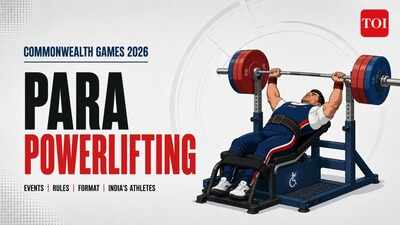
Para Powerlifting is one of the most demanding strength sports at the Commonwealth Games, with athletes pushing themselves to lift the heaviest possible weight in a contest where technique is just as important as power. Unlike Weightlifting, which features two disciplines, Para Powerlifting focuses solely on the bench press, making every attempt crucial in determining the final standings.Success depends on more than physical strength. Competitors must demonstrate complete control throughout the lift while meeting strict technical requirements before receiving approval from the officials.At the Glasgow 2026 Commonwealth Games, Para Powerlifting will once again bring together athletes from across the Commonwealth in a series of contests where every successful lift could prove decisive.
How Para Powerlifting works
Para Powerlifting is contested in the bench press discipline.To complete a successful lift, athletes must lower the barbell to their chest, hold it motionless and then press it upward until their arms are fully extended with locked elbows.Each competitor receives three attempts to record their best lift.Every attempt is judged by three international referees, who use a system of coloured lights to determine whether the lift is successful.
- Two or more white lights indicate a successful lift.
- Two or more red lights indicate an unsuccessful attempt.
The athlete with the heaviest successful lift at the end of the competition is declared the winner.A fourth attempt may be permitted for a world record, although it does not count towards the final competition standings.
What to expect at Glasgow 2026
Para Powerlifting at Glasgow 2026 promises a series of closely contested competitions where every kilogram can influence the final rankings.With only three attempts available, athletes must carefully plan their strategy while balancing ambition with consistency. Every successful lift carries added significance as competitors attempt to improve their position on the leaderboard.The discipline also highlights remarkable upper-body strength, with athletes often lifting weights several times their own body weight. Combined with the technical demands of the sport and the scrutiny of the referees, every successful attempt is expected to draw plenty of attention throughout the Games.
Did you know?
- Para Powerlifting was introduced to the Commonwealth Games in Manchester 2002, while the women’s competition was added at Delhi 2010.
- Athletes compete only in the bench press discipline.
- Every lift is judged by three international referees using a white-light and red-light system.
- A fourth lift may be allowed for a world record, but it does not count towards the competition rankings.
India’s athletes in Para Powerlifting
India will be represented by the following athletes in Para Powerlifting at the Glasgow 2026 Commonwealth Games:
- Parmjeet Kumar
- Sudhir
- Jhandu Kumar
- Ashok
- Jaspreet Kaur
- Kasthuri Rajamani
- Suman Devi