Building strong legs is about more than simply squatting heavy weights. According to strength coach Lauren Pak, athletic lower-body development requires qualities that many traditional gym programs overlook.
In a recent video on the Jason and Lauren YouTube channel, Pak explained that athletes need more than brute strength. They must be able to stabilize on one leg, move efficiently in multiple directions, absorb force, and generate power quickly.
“If you want to build legs like an athlete, you need more than just brute strength in perfectly balanced positions,” Pak said.
To develop those qualities, she highlighted three training methods she regularly uses: single-leg strength work, multiplanar movement training, and loaded power exercises.
Single Leg Strength (Skater Squat)
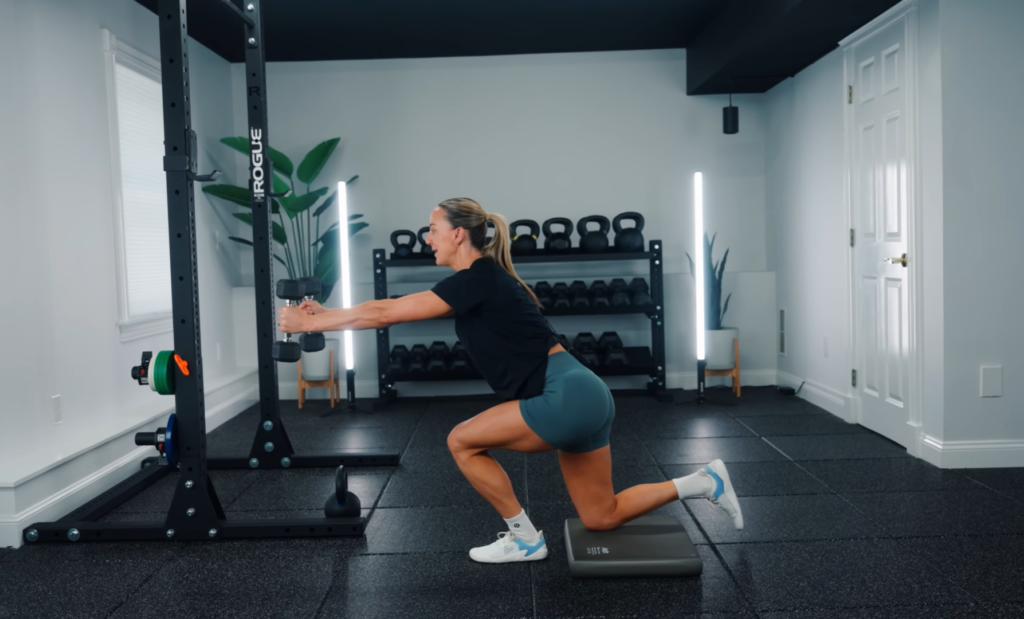
Pak believes single-leg strength is one of the most neglected qualities in fitness programs.
While traditional exercises such as squats, deadlifts, leg presses, and leg extensions can build impressive strength, most sports and daily activities occur one leg at a time.
“Whether you’re walking, running, jogging, jumping, cutting, you’re doing things on one leg at a time,” she explained.
One of her favorite exercises for developing this quality is the skater squat. Unlike a reverse lunge, the trailing leg remains elevated throughout the movement, forcing the working leg to control both balance and force production.
Pak used the exercise extensively during her ACL rehabilitation and credits it with helping address side-to-side imbalances that often develop after injury.
She recommends beginners start with TRX straps or rings for assistance before progressing to weighted counterbalance variations and eventually heavier goblet-loaded skater squats.
Multiplanar Movements (Slider Lateral Lunge)
The second component of athletic leg training involves moving outside the traditional forward-and-back plane. Many lower-body exercises occur in the sagittal plane, but sports frequently demand side-to-side movement, rotation, and changes of direction.
“Your body is meant to move in all directions, and so we want to train your legs to move in all directions,” Pak said.
To develop this ability, she recommends the slider lateral lunge. Using a furniture slider beneath one foot, the exercise challenges the adductors, glutes, hamstrings, and quadriceps while teaching athletes to control movement laterally.
Pak noted that loading position can alter the training effect. Holding a weight in a goblet position encourages a more upright torso and greater quadriceps involvement, while lower loading positions increase emphasis on the glutes and hamstrings.
Loaded Power (Trap Bar Deadlift Jumps)
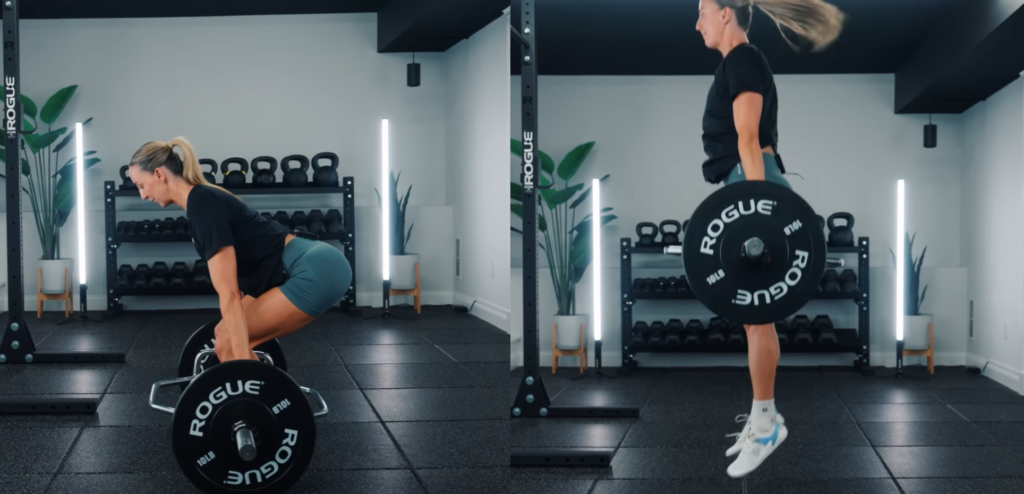
The final element of athletic lower-body development is power.
While strength is the ability to produce force, power is the ability to produce force quickly.
“A lot of people can move a lot of weight slowly, but athleticism is also about being able to produce force quickly,” Pak explained.
One of her preferred methods is the trap bar deadlift jump.
Unlike heavy deadlifts, the goal is not maximal loading. Instead, athletes use a relatively light weight while focusing on explosive triple extension through the hips, knees, and ankles.
Pak emphasized resetting between repetitions rather than rushing through sets.
“It’s not about getting tired, it’s about moving explosively and using power,” she said.
Building Legs That Perform
Pak’s message is not that traditional strength training should be abandoned. Squats, deadlifts, and other foundational lifts remain valuable tools.
However, by incorporating single-leg exercises, multiplanar movement patterns, and power-focused training, athletes can develop lower-body strength that transfers more effectively to sport and everyday life.
As Pak concludes, the goal is to build legs that not only look strong but perform like it as well.
About the Author
Jeremiah Oliva

Jeremiah Oliva is a writer passionate about fitness, sports, and active living. He has experience in songwriting and managing content and social media for online radio and magazine platforms.
He covers HYROX, CrossFit®, and competitive fitness, with a focus on performance, mindset, and athlete development.
Outside of writing, Jeremiah trains in boxing, cycles, explores the outdoors with his kids, and plays the guitar.