Bodyweight training gets a bad rap in serious lifting circles.
But Dr. Mike Israetel from Renaissance Periodization just dropped a complete upper body workout that requires almost nothing—and promises to “nuke” every muscle from chest to rear delts.
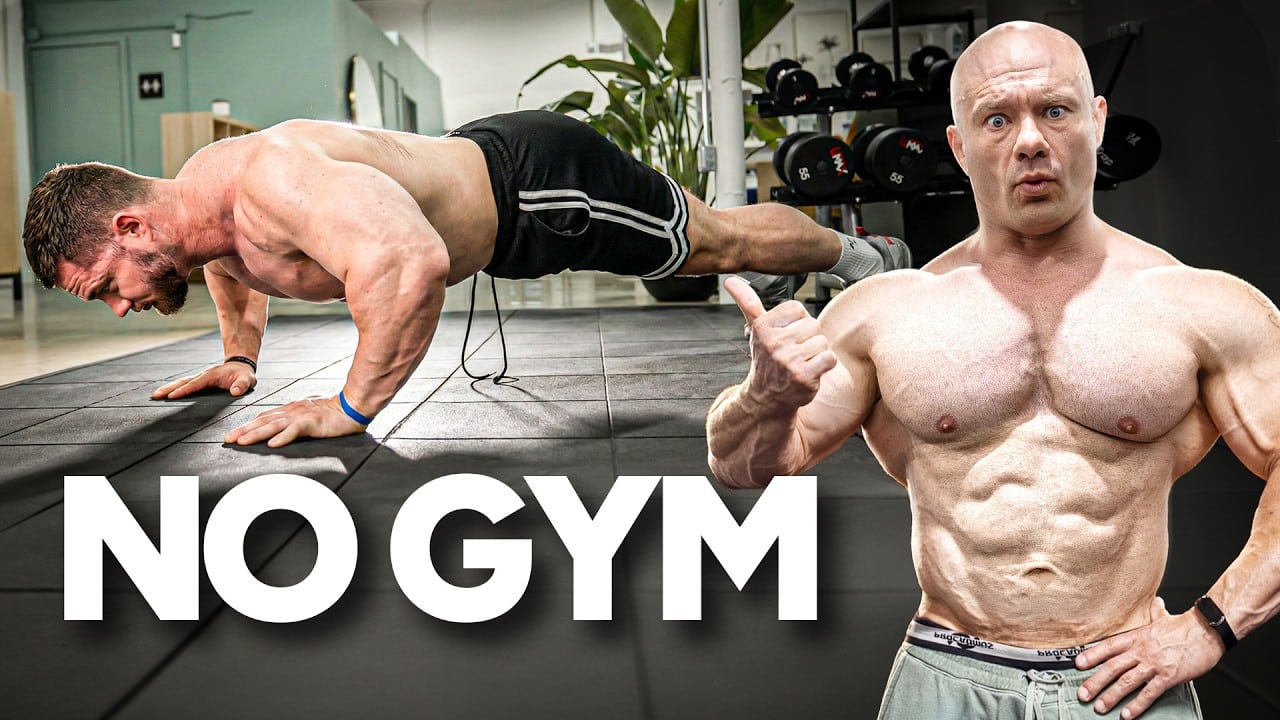
In a recent YouTube video alongside IFBB Pro Jared Feather, Dr. Mike demonstrated a rapid-fire circuit that can be done in a power rack, Smith machine, or even at home with a pull-up bar and two chairs.
The best part? It takes minimal time but demands maximum effort.
Minimal Equipment, Maximum Results
Dr. Mike’s workout is designed for accessibility. Whether you’re stuck at home or fighting for space in a crowded gym, this routine adapts.
You can do this at home if you have anywhere to do pull-ups on and you have two chairs and a broom handle.
He recommends an adjustable pull-up bar that mounts in doorways—the kind that cinches to the sides rather than hanging from the top. This allows height adjustments for different exercises.
For those without fancy equipment, a sturdy broom handle balanced between two chairs works perfectly for inverted movements. Just test stability first.
The Strategic Exercise Order
Exercise sequence matters tremendously in this protocol. Dr. Mike structures the workout to target larger muscle groups first, then progressively shift emphasis toward smaller muscles.
What we want to do is start with a challenge more to the back and chest and eventually lead the challenge to be more to the shoulders and arms.
This approach ensures maximum stimulus for chest and back before fatigue compromises form. Shoulders and arms get hammered later when they’re fresh relative to the larger muscles.
The Complete Exercise Sequence
The workout consists of eight exercises performed back-to-back with minimal rest:
- Sternum Pull-Ups: Full range pulling to just below the nipple line
- Wide Grip Push-Ups: Elbows flared, chest touching ground
- Chin-Height Pull-Ups: Standard pull-ups to chin level
- Medium Grip Push-Ups: More front delt and tricep emphasis
- Underhand Pull-Ups: Heavy bicep and rear delt involvement
- Diamond Push-Ups: Maximum tricep destruction
- Inverted Rows: Back thickness and mid-back focus
- Inverted Face Pulls: Final rear delt burnout
The Warm-Up Protocol
Dr. Mike emphasizes proper preparation before diving into sternum pull-ups—the most demanding movement in the sequence.
Jared demonstrates a three-stage warm-up: partial “shrug ups” covering one-third range of motion, then half pull-ups, finally full chin-height reps. Each stage includes brief 10-30 second rest periods.
Do not just get into these sorts of situations. It’s a very hardcore exercise.
This progressive approach primes lats, biceps, rear delts, and crucially, shoulder and elbow joints for the intense work ahead.
Rest Periods: The Five-Second Rule
Transitions between exercises are brutally short—approximately five seconds.
This creates significant cardiovascular demand alongside muscle stimulus. Dr. Mike describes the dual benefit: maximum time efficiency and enhanced conditioning.
However, he acknowledges reality. If rep counts drop below five per set, extending rest to 30 seconds preserves workout quality without excessive time addition.
A couple extra 30 seconds of rest isn’t going to blow out your workout to minutes and minutes and minutes longer.
Scaling For Different Strength Levels
Sternum pull-ups present the biggest challenge for most trainees. Dr. Mike offers several modifications.
Beginners can substitute additional chin-up sets or use assisted variations with feet on ground. Setting an adjustable bar lower allows leg assistance at bottom positions.
For push-up variations, elevating hands on chairs, couches, or benches reduces difficulty. This lever advantage helps less experienced lifters complete prescribed rep ranges.
Jared noted that even advanced variations exist. Dive bomber push-ups can replace diamond push-ups for those seeking greater challenges.
Optimal Rep Ranges
Dr. Mike recommends maintaining 10-20 reps per set for ideal muscle growth and cardiovascular benefit.
Five reps represents the minimum threshold. Dropping below this signals need for exercise regression or extended rest periods.
Progression Strategies
This workout allows multiple progression pathways beyond single-set execution.
Adding reps provides straightforward linear progression. Tracking workouts in the RP Hypertrophy app helps monitor weekly improvements from 10 to 11 to 12 reps per movement.
Increasing sets multiplies total volume. Rather than one giant circuit, perform two or three rounds of the entire sequence. Dr. Mike suggests eventually building to four or five sets per exercise.
If you get into doing this workout and you do four or five sets of each one of these movements all in sequence with five to 30 seconds rest as needed, you are going to nuke your upper body into outer space.
Weekly Programming For Balanced Development
Dr. Mike outlines intelligent weekly structure for those using this as primary upper body training.
Perform the workout twice weekly with different emphases. Early week sessions prioritize chest and back with 2-3 sets of sternum pull-ups, wide grip push-ups, regular pull-ups, and medium push-ups. Later movements receive just one set.
Later in the week, reverse this approach. Reduce early movement sets to one or two, then increase volume on diamond push-ups, underhand pull-ups, inverted skull crushers, and face pulls to 2-4 sets each.
This creates chest/back emphasis early week and shoulder/arm emphasis later, preventing overtraining while maintaining balanced development.
Technical Execution: Non-Negotiable Form Standards
Dr. Mike repeatedly stresses technique throughout the demonstration.
Every repetition demands controlled eccentric lowering, full stretch at bottom positions, and complete range of motion. No bouncing at bottom. No resting at top.
Always, always good technique. If you’re getting tired and you can’t get as many reps anymore, don’t fudge the technique. Just take a break.
Maintaining form standards minimizes injury risk and maximizes muscle stimulus—especially crucial during metabolically demanding circuits.
Inverted Movement Technique
Bar height determines difficulty for inverted exercises. Waist height works for most on inverted rows. Stronger individuals can lower to knee height for inverted skull crushers.
Foot positioning also modulates intensity. Walking feet closer to bar increases difficulty; stepping back reduces load.
Face pulls require special attention to elbow mechanics. Dr. Mike emphasizes pulling elbows back rather than performing rowing motions, ensuring proper rear delt engagement.
What About Leg Training?
This protocol deliberately focuses solely on upper body musculature.
Dr. Mike acknowledges the channel features separate minimalist leg workouts using dumbbells. He teased potential future bodyweight leg protocols, though warned they’re exceptionally challenging.
For complete physique development, pair this upper body routine with dedicated lower body training days using available equipment.
Real-World Testing: The Pro’s Experience
After completing the single-set version, Jared Feather—an IFBB professional bodybuilder—provided honest feedback.
It’s different. A lot of metabolites. Especially taking everything to failure.
He confirmed the workout’s legitimacy despite minimal equipment, praising its versatility for vacations, home training, or equipment-limited situations.
Dr. Mike noted achieving substantial pump from just one circuit, demonstrating effectiveness even for advanced trainees when executed with proper intensity.
The Effort Equation
Dr. Mike frames the workout’s value proposition clearly: exceptional results in minimal time, but only with corresponding effort investment.
What’s the trade-off? It’s not magic. The denominator is effort. You have to bring your amazing effort to this.
Short rest periods create cardiovascular challenge alongside muscular stimulus. The workout checks boxes for muscle growth, strength, mobility, and conditioning simultaneously.
This efficiency appeals particularly to time-constrained individuals seeking comprehensive upper body development without gym dependence.
Practical Applications
This protocol shines in specific scenarios:
- Travel situations where gym access disappears
- Crowded gym periods when equipment availability limits options
- Home training with minimal equipment investment
- Active recovery days requiring lighter loads but movement quality
- Conditioning phases emphasizing metabolic stress
The workout’s adaptability across equipment scenarios and fitness levels makes it genuinely accessible rather than theoretically so.
For those seeking structured guidance, Dr. Mike recommends the RP Hypertrophy app for generating customized versions and tracking progressive overload—though he acknowledges the workout’s simplicity allows execution without digital tools.
Whether performed as emergency backup training or primary upper body protocol, this circuit delivers legitimate stimulus. Just be prepared for the metabolic suffering that comes with five-second rest periods and pushing every set close to failure.